
Attendees: Event is free and open to the public
For event photos and videos (you are encouraged to also share yours): here (partiful app).
PROGRAM
Location: Northwestern University (Evanston, IL – Chicago area)
In-person event.
FRIDAY, APRIL 11, 2025
12:15pm-1:15pm: Registration & Welcome (Harris Hall, Rm108)
1:20pm-2:40pm: Panel Session 1 Narratives of Decolonial Feminist Justice
(Harris Hall, Rm 108)
Valentina Wiñay Wara Quispe Isnado, Centre College, “Decolonización y Desoccidentalización de la Educación Sexual Integral para Combatir los Embarazos Adolescentes No Deseados en Bolivia”
Gloria Macedo-Janto, University of Oregon, “Mujeres andinas sin futuro: estereotipos de género en la narrativa de la violencia política en Perú”
Brianna Griesinger, Queen’s University Belfast, “Navigating the Legacy of Conflict through Practices of Aynikawsay: A Gaze into the Intersectional Communitarian Feminist Praxis of Storytelling in Pursuit of Reproductive Justice in Peru”
Rocío Ferreira, DePaul University, “Memoria y violencias en los Andes en la narrativa de Karina Pacheco Medrano”
2:45-3pm Coffee break
3pm-4:20pm Panel Session 2 New Cultural Production from El Alto, Bolivia
(Harris Hall, Rm 108)
Carolyn Wolfenzon, Bowdoin College, “Identidades migrantes en El Gran Movimiento de Kiro Russo y Seúl Sao Paulo de Gabriel Mamani Magne”
Raquel Alfaro, University of Rochester, “Angustias comunicantes en Altopía y Helena 2022”
Tara Daly, Marquette University, “El humor incongruente en las nuevas crónicas alteñas”
Daniel Runnels, University of Central Missouri, “Lo abyecto en ‘Perro Gris’”
4:20pm-4:40pm Coffee Break
4:40pm- 6pm Panel Session 3A Migrations, Ruptures, and Development
(Kresge Hall, Rm 3535)
Tess Renker, Georgetown University, “Internal Migration and Mobile Immobility in José María Arguedas’s Los ríos profundos (1958)”
Daniel Ospina Pérez, Northwestern University, “The Túquerres Earthquake: Building Liberal Modernity on Colombia’s Andean Borderlands (1935-1940)”
Emilia Tamayo, Northwestern University, “Un turista en mi camino: Colombian Childhood in the Tourist’s Gaze”
Ximena Briceño, Stanford University, “Escalas y desarrollo: El futuro del guano con Vallejo y Arguedas”
4:40pm-5:45pm Panel Session 3B Indigenous Pedagogies: Land, Family, Language
(Kresge Hall, Rm 3438)
Rubén Pachas, Art Institute of Chicago, “Teaching Peruvian Indigenous Dance to Non-Indigenous people”
Carlos Flores Quispe & Meghan Armstrong, UMass-Amherst, “Creencias Culturales del Cuidado Proximal en Chuquisaca – Bolivia”
Américo Mendoza-Mori, Harvard University, “Embracing ‘Ayni’;: The relevance of Indigenous Languages and Cultures in the Humanities”
6pm- 6:15pm: Hors d’oeuvres (Harris Hall, Rm. 108)
6:15-7pm Short Film + QA (Harris Hall, Rm. 108)
Hatarimuy (dir. Suni Sonqo Vizcarra Wood, Quechua Nation, Member of Ñawpa Ñan Cultural Community in Taray (Cusco), Peru; Kusi Kawsay Association; Graduate student, School of the Art Institute of Chicago). Q&A moderated by Carlos Molina-Vital (University of Illinois, Urbana-Champaign)
7pm Concert with Special Musical Guest
SATURDAY, APRIL 12, 2025
9am Light Breakfast (Harris Hall, Rm. 108)
9:30-10:50am Panel Session 4 Ecological and Territorial Struggles
(Harris Hall, Rm. 108)
José Saldaña Cuba, McGill University, “Legalidades eco-territoriales emergentes en la región andina: Los seres de la tierra y la gran minería en la provincia de Espinar (Cusco)”
Nicholas Carby Denning, Bryn Mawr College, “Extractivism and the Rights of Nature”
Kathleen Julca, Massachusetts Institute of Technology, “The impact of water quality testing for Andean Water Planning in the Lake Titicaca Basin in the community Pukachupa, Pucará”
Thomas Martynowicz, University of Southern California-Law, “Pachamama and Policy: Exploring the Role of Nature’s Legal Status in Peru’s Free, Prior, and Informed Consent Process”
10:55am-12:15pm Panel Session 5 The Power of Collective Memory
(Harris Hall, Rm. 108)
Cecilia Beltrán Rodríguez, University of Washington-Seattle: “Entre la epopeya y la tragedia: El papel de la crónica en la política y la memoria colectiva de Bolivia”
Marlen Rosas, Haverford College, “Recording a Usable Past: Indigenous Communists’ Memories and Narrative Power in Ecuador”
Kleber Naula Yautibug, University of North Carolina-Chapel Hill, “Yuyarina (Remembering) Concept in the Ecuadorian Andean Indigenous Memory”
Yvette Ramirez, University of Michigan, “Sentirpensar: Memorizing through the Heart”
12:25-1:30pm Panel Session 6A Religious Rituals, Resistance, Representation
(Kresge Hall, Trienens Forum – Rm 1515)
Eddy Santiago Huamani, Indiana University, “Resistencia Y Sincretismo En La Representación Del Huaca Llocllayhuancu En Dioses y Hombres de Huarochirí”
Ximena Gallegos Gutierrez, University of Washington-College of Education, “Land as Sacred: Teacher Reflections on Andean Rituals”
Ricardo Soler Rubio, University of Chicago, “De la ritualidad como técnica. La reapropiación contemporánea de la Virgen del Cerro (ca 1680) en Atomito de Liliana Colanzi (2022)”
12:25-1:30pm Panel Session 6B Puntos de inflexión en los estudios andinos (1960-2024)
(Kresge Hall, Rm 3535)
Nicolás Aguía Betancourt, Ohio State University, “Fratricidio y acumulación primitiva en Todas las sangres (1964), de José María Arguedas”
Ulises Juan Zevallos Aguilar, Ohio State University, “Muerte y resurrección en el mito de Inkarri”
Victor Vimos, Ohio State University, “Guamote. Articulaciones políticas entre seres humanos y montañas.”
1:35-2:55pm Lunchtime Roundtable Reflexiones sobre los estudios andinos (Harris Hall, Rm. 108)
Jorge Coronado, Northwestern University, “Lo andino: contextos y consideraciones”
Valeria Coronel Valencia, FLACSO, “Genealogía crítica y política del significante andino para pensar la modernidad desde los andes”
3pm-4:20pm Panel Session 7 Theorizing Methods, Philosophies, and Frameworks
(Harris Hall, Rm 108)
Mercedes Mayna-Medrano, Union College, and Juan-Pablo Cárdenas, Massachusetts College of Art and Design, “Towards an Andean-Amazonian Frame of Reference”
Arnold Arnez, Independent, “Historicizing Andean Philosophy: A Transnational Overview”
C.A.R. Hawkins Lewis, Northwestern University, “Andean Diagnostics of Extractivism: Pishtaco Stories, Histories of Community Harm, and Non-Extractive Outsider Research”
Diego Arispe-Bazán, Northwestern University, “‘Blanquitud’ as Qualia: Semiotics of Race”
4:30-4:35 Coffee break
4:35-5:55pm Panel Session 8 Recuperation and Empowerment through Alternative Arts
(Harris Hall, Rm 108)
Gabriel Antúnez De Mayolo Kou, University of Wisconsin-La Crosse, “Cumbia in Hi-Fi: sounds and images of the Peruvian psychedelic cumbia record”
Evelyn Saavedra Autry, Rutgers University, “Singing Feminist Ch’ixi + art Music from las Rajaduras: Renata Flores, Isqun, and the Fractured Locus”
Lenin Lozano-Guzmán, Bryn Mawr College, “¿Revolución militar y/o andina?: indigeneidad y memoria de la reforma agraria en el arte peruano contemporáneo”
Enzo Vasquez Toral, University of Texas-Austin, “Cholita Transformistas: Decolonizing Beauty and Rethinking LGBT Pageants as Political Activism”
6pm-7pm Keynote Speaker: Javier Puente, Smith College, “Andean Lessons Against Authoritarianism” (Harris Hall, Rm. 108)
CAMPUS MAP:




DEADLINE FOR PROPOSALS: January 17, 2025, 5pm CT.
*Click aquí para convocatoria en español
Sponsored by the Latin American and Caribbean Studies Program and Andean Cultures and Histories Working Group at Northwestern University.
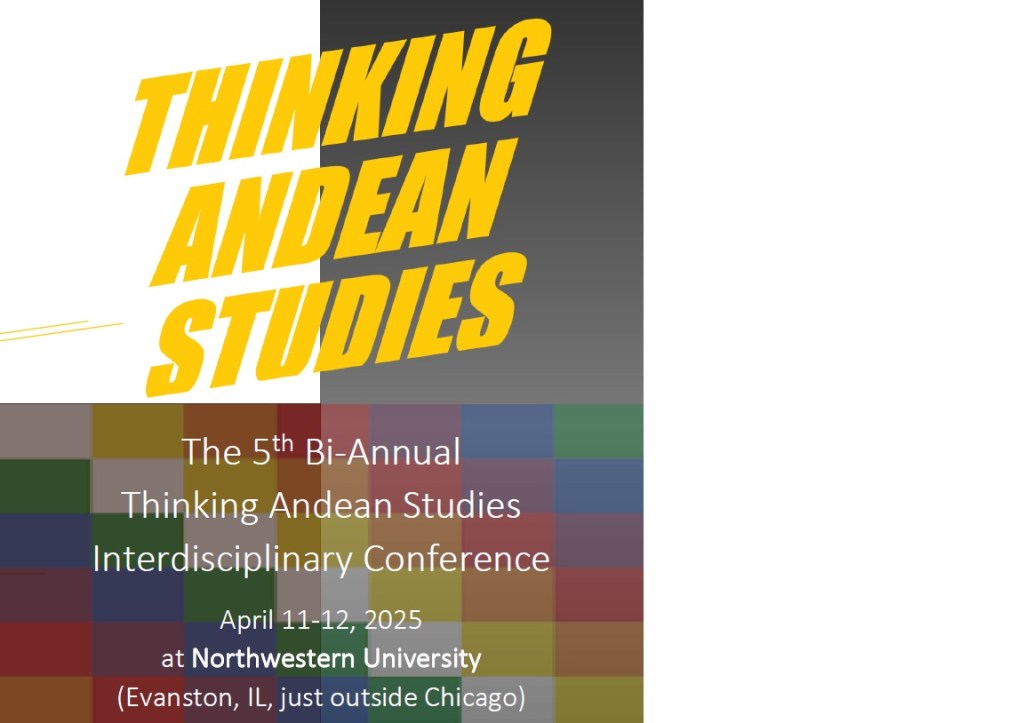
The 5th edition of the Thinking Andean Studies conference will take place on April 11-12, 2025 at Northwestern University (Chicago Area)! We will continue our mission to strengthen the interdisciplinary network of scholars thinking through theory and praxis from the Andes. We invite you to another opportunity to help foster a mentoring relationship between established and emerging scholars.
As always, our event will provide a space for participants to share their research through paper presentations and roundtable discussions, and hopes to showcase the increasing number of scholars globally conducting research in and about the Andes.
In previous editions, we have asked participants to consider the importance of working across disciplines, and how to potentially theorize the Andes (Bolivia, Ecuador, Peru, and Colombia, as well as northern Argentina and Chile). This year, we invite participants to reflect on the long historical arc that has led to contemporary developments in politics, economics, cosmovision, philosophy, and culture in the region. What were the conditions that set up contemporary states of affairs in the region, and how can studying the relation between past and present help us (potentially) make interventions today.
Ideally, papers will reflect on some of the power dynamics that intersect to shape various facets of Andean societies. This interdisciplinary conference also will also aim to connect scholars with Indigenous language and culture advocates. In this spirit, the Conference will include presentations that explore the intersections of indigenous languages of the Andes and media and activism, language pedagogy, literature, performance, and community organizing.
Papers from any theoretical perspective and examining any aspect of the Andes are welcome, including, but not restricted to: cultural studies, cultural policy, literature, indigenous studies, language planning and policy, bilingual education, decolonization, colonial studies, anthropology, sociology, cultural heritage and reclamation, political science, linguistics, media studies, ethnicity, ethnomusicology, and history. Papers can be in English, Spanish or any of the languages spoken in the Andean region.
Sessions will take place on April 11 and 12, 2025 at Northwestern University, in Evanston, IL (on the border of the city of Chicago). Please submit a paper title, presenter’s name, institutional affiliation, abstract of 250 words maximum to Dr. Américo Mendoza-Mori (americo_mendoza@fas.harvard.edu) by January 17, 2025. Applicants have the option to submit panel applications, which should include panel title along with each presenter’s abstract. In-person event.
Responses will be made available by February 3, 2025 to all who submitted.
The Thinking Andean Studies Conference is made possible this year by the following generous sponsors at Northwestern:
 Thinking Andean Studies